
NFL Tiebreakers Explained
When two or more NFL teams finish with the same record, the league does not flip a coin first.
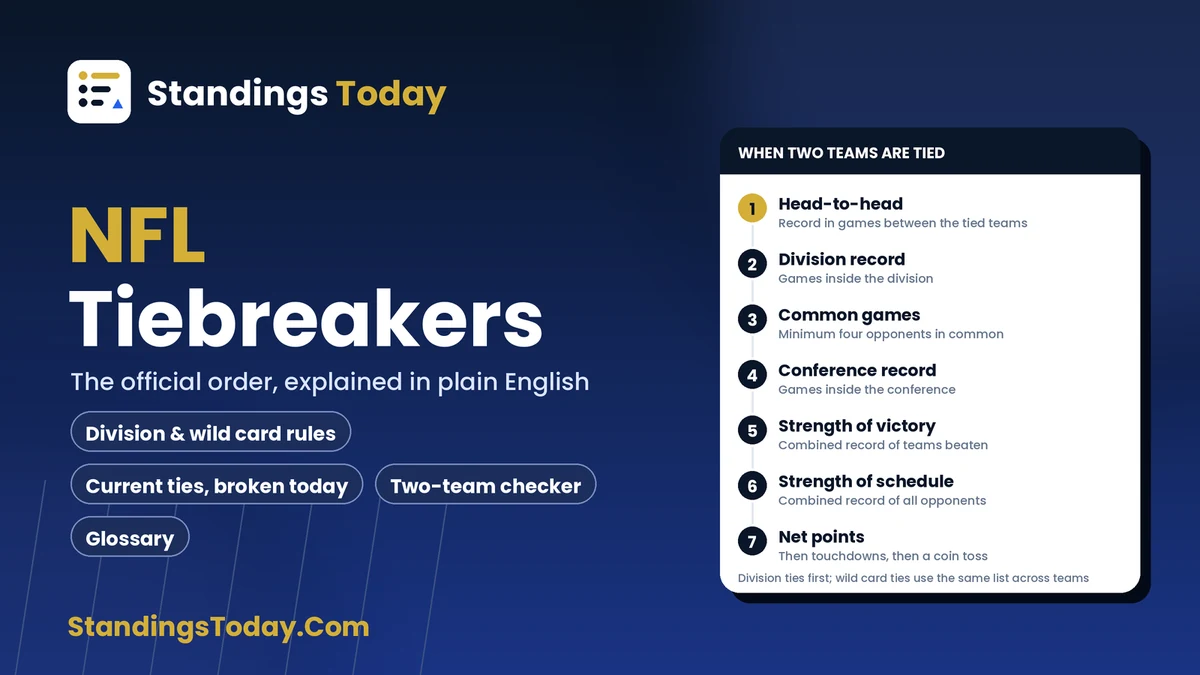
It works through a fixed list of tiebreakers and stops at the first one that separates the teams. Division ties are settled before wild card ties, and the order of the steps is slightly different for each.
This page explains every step in plain English, shows which 2026 races are currently tied and how they would be broken today, and lets you compare any two teams.
Current Ties in the 2026 Standings
Teams in the same conference with identical records, and the step that separates them right now. Playoff seeding uses these exact comparisons.
 Kansas City ChiefsAFC West · AFC No. 1
 Buffalo BillsAFC East · AFC No. 2
| Step | Chiefs | Bills |
|---|---|---|
| Head-to-headThe teams have not met yet, so this step is skipped. | not played | not played |
| Common games (min. 4)Not enough common opponents yet. | 2-0 | 2-0 |
| Conference record | 5-0 | 3-1 |
| Strength of victory | 11-22 (.333) | 12-21 (.364) |
| Strength of schedule | 15-25 (.375) | 16-24 (.400) |
| Net points (all games) | +40 | +26 |
The Kansas City Chiefs rank ahead on conference record.
 Cleveland BrownsAFC North · AFC No. 3
 Denver BroncosAFC West · AFC No. 5
 Pittsburgh SteelersAFC North · AFC No. 6
With three teams tied, the combined head-to-head record among them comes first. Taking the order as it stands today, the Browns sit ahead of the Broncos in the seeding order and the Broncos are ahead of the Steelers on conference record.
 Jacksonville JaguarsAFC South · AFC No. 4
 Cincinnati BengalsAFC North · AFC No. 7
| Step | Jaguars | Bengals |
|---|---|---|
| Head-to-head | 1-0 | 0-1 |
| Common games (min. 4) | 0-1 | 1-0 |
| Conference record | 3-2 | 3-2 |
| Strength of victory | 15-11 (.577) | 9-18 (.333) |
| Strength of schedule | 22-18 (.550) | 18-22 (.450) |
| Net points (all games) | +50 | +41 |
The Jacksonville Jaguars rank ahead on head-to-head.
 New England PatriotsAFC East · AFC No. 8
 Baltimore RavensAFC North · AFC No. 9
| Step | Patriots | Ravens |
|---|---|---|
| Head-to-headThe teams have not met yet, so this step is skipped. | not played | not played |
| Common games (min. 4)Not enough common opponents yet. | - | - |
| Conference record | 4-1 | 2-2 |
| Strength of victory | 15-12 (.556) | 8-19 (.296) |
| Strength of schedule | 28-19 (.596) | 19-28 (.404) |
| Net points (all games) | +17 | +2 |
The New England Patriots rank ahead on conference record.
 New York JetsAFC East · AFC No. 11
 Indianapolis ColtsAFC South · AFC No. 12
 Houston TexansAFC South · AFC No. 13
With three teams tied, the combined head-to-head record among them comes first. Taking the order as it stands today, the Jets are ahead of the Colts on conference record and the Colts are ahead of the Texans on head-to-head.
 New York GiantsNFC East · NFC No. 3
 Washington CommandersNFC East · NFC No. 16
| Step | Giants | Commanders |
|---|---|---|
| Head-to-head | 0-0-1 | 0-0-1 |
| Division record | 1-0-1 | 0-2-1 |
| Common games | 1-0 | 0-1 |
| Conference record | 2-2-1 | 1-3-1 |
| Strength of victory | 7-20 (.259) | 4-3 (.571) |
| Strength of schedule | 13-33-1 (.287) | 20-19-1 (.513) |
| Net points (all games) | +2 | -40 |
The New York Giants rank ahead on division record.
 Green Bay PackersNFC North · NFC No. 7
 Seattle SeahawksNFC West · NFC No. 8
| Step | Packers | Seahawks |
|---|---|---|
| Head-to-headThe teams have not met yet, so this step is skipped. | not played | not played |
| Common games (min. 4)Not enough common opponents yet. | - | - |
| Conference record | 3-3 | 1-2 |
| Strength of victory | 11-16 (.407) | 11-15 (.423) |
| Strength of schedule | 24-22 (.522) | 23-22-1 (.511) |
| Net points (all games) | -1 | +43 |
The Green Bay Packers rank ahead on conference record.
 Atlanta FalconsNFC South · NFC No. 9
 Los Angeles RamsNFC West · NFC No. 10
| Step | Falcons | Rams |
|---|---|---|
| Head-to-headThe teams have not met yet, so this step is skipped. | not played | not played |
| Common games (min. 4)Not enough common opponents yet. | 1-0 | 0-1 |
| Conference record | 3-2 | 2-2 |
| Strength of victory | 12-9 (.571) | 9-10-1 (.475) |
| Strength of schedule | 29-19 (.604) | 27-19-1 (.585) |
| Net points (all games) | -2 | +11 |
The Atlanta Falcons rank ahead on conference record.
 Philadelphia EaglesNFC East · NFC No. 11
 Dallas CowboysNFC East · NFC No. 12
| Step | Eagles | Cowboys |
|---|---|---|
| Head-to-headThe teams have not met yet, so this step is skipped. | not played | not played |
| Division record | 1-0 | 1-1 |
| Common games | 1-0 | 1-0 |
| Conference record | 1-3 | 1-3 |
| Strength of victory | 2-10-1 (.192) | 3-9-1 (.269) |
| Strength of schedule | 17-21-1 (.449) | 17-22-2 (.439) |
| Net points (all games) | -31 | -8 |
The Philadelphia Eagles rank ahead on division record.
 Tampa Bay BuccaneersNFC South · NFC No. 13
 New Orleans SaintsNFC South · NFC No. 14
 Arizona CardinalsNFC West · NFC No. 15
With three teams tied, the combined head-to-head record among them comes first. Taking the order as it stands today, the Buccaneers are ahead of the Saints on division record and the Saints are ahead of the Cardinals on conference record.
Tiebreaker Checker
Pick any two NFL teams. The checker walks the official order using this season's results and stops at the first step that separates them.
The Official Tiebreaker Order
Two teams tied for a division title. With three or more, head-to-head means the combined record among all tied teams, and if one team drops out the list restarts from step 1 for the rest.
- 1
Head-to-head
The record in games between the tied teams. In the NFL every division pair plays twice, so a sweep settles most two-team ties on the spot.
Example Chiefs 11-6, Chargers 11-6. Chiefs won both meetings: Chiefs take the division.
- 2
Division record
Win-loss-tie record in games against the other three teams in the division (six games a season).
Example If the head-to-head is split 1-1, a 5-1 division record beats 4-2.
- 3
Common games
Record against opponents both teams played. Division rivals share most of their schedule, so this usually covers 12 to 14 games.
Example Two teams both played the Ravens, Bills and Dolphins. Going 3-0 in those games beats 2-1.
- 4
Conference record
Record against all teams in the same conference (usually 12 games).
Example A 9-3 AFC record beats 8-4.
- 5
Strength of victory
The combined record of every team you beat. Beating good teams counts for more than beating bad ones.
Example Wins over teams that finished a combined 60-42 (.588) beat wins over teams at 50-52 (.490).
- 6
Strength of schedule
The combined record of every opponent you played, win or lose.
Example A schedule of opponents at .530 beats one at .500.
- 7
Points ranking in the conference
Best combined ranking among conference teams in points scored and points allowed.
Example Ranking 3rd in scoring and 5th in defense (8) beats 4th and 6th (10).
- 8
Points ranking in the league
The same combined ranking, measured against all 32 teams.
- 9
Net points in common games
Points scored minus points allowed, only in the common games from step 3.
- 10
Net points in all games
Season point differential.
Example +95 beats +40.
- 11
Net touchdowns
Touchdowns scored minus touchdowns allowed in all games.
- 12
Coin toss
Almost never reached. The last resort.
Two or more teams tied for a wild card spot, or for seeding among division winners.
- 1
Same division first
If the tied teams are from the same division, the division tiebreaker above is applied first. Only one team from a division can advance at each step.
- 2
Head-to-head
Used only if the teams have played each other. Teams from different divisions often have not, so this step is frequently skipped.
Example Texans beat the Steelers in Week 6: Texans win a two-team wild card tie.
- 3
Conference record
Record against conference opponents. This is the step that decides most wild card ties in practice.
- 4
Common games (minimum four)
Record in games against shared opponents, but only if there are at least four such games.
- 5
Strength of victory
Combined record of all teams beaten.
- 6
Strength of schedule
Combined record of all opponents.
- 7
Points ranking in the conference
Combined ranking in points scored and allowed among conference teams.
- 8
Points ranking in the league
The same ranking across all teams.
- 9
Net points in conference games
Point differential in conference games only.
- 10
Net points in all games
Season point differential.
- 11
Net touchdowns
Touchdowns scored minus allowed.
- 12
Coin toss
Last resort.
Strength of Victory and Strength of Schedule
Updated after every game. Sort a column to see who has beaten the toughest opponents and who has the hardest road. Tap a heading to sort.
| # | Team | Record | SOV | SOS | Net pts |
|---|---|---|---|---|---|
| 1 |  Minnesota VikingsMINNFC Minnesota VikingsMINNFC |
6-0 | .390 16-25 | .390 16-25 | +51 |
| 2 |  San Francisco 49ersSFNFC San Francisco 49ersSFNFC |
6-1 | .413 16-23-1 | .415 19-27-1 | +58 |
| 3 | Kansas City ChiefsKCAFC |
5-1 | .333 11-22 | .375 15-25 | +40 |
| 4 | Buffalo BillsBUFAFC |
5-1 | .364 12-21 | .400 16-24 | +26 |
| 5 |  Chicago BearsCHINFC Chicago BearsCHINFC |
5-2 | .424 14-19 | .522 24-22 | +37 |
| 6 | Pittsburgh SteelersPITAFC |
5-2 | .382 13-21 | .458 22-26 | +15 |
| 7 | Denver BroncosDENAFC |
5-2 | .394 13-20 | .522 24-22 | +3 |
| 8 | Cleveland BrownsCLEAFC |
5-2 | .441 15-19 | .447 21-26 | -13 |
| 9 | Jacksonville JaguarsJAXAFC |
4-2 | .577 15-11 | .550 22-18 | +50 |
| 10 | Cincinnati BengalsCINAFC |
4-2 | .333 9-18 | .450 18-22 | +41 |
| 11 |  Detroit LionsDETNFC Detroit LionsDETNFC |
4-2 | .357 10-18 | .450 18-22 | +19 |
| 12 | New York GiantsNYGNFC |
4-2-1 | .259 7-20 | .287 13-33-1 | +2 |
| 13 | Seattle SeahawksSEANFC |
4-3 | .423 11-15 | .511 23-22-1 | +43 |
| 14 | New England PatriotsNEAFC |
4-3 | .556 15-12 | .596 28-19 | +17 |
| 15 | Baltimore RavensBALAFC |
4-3 | .296 8-19 | .404 19-28 | +2 |
| 16 | Green Bay PackersGBNFC |
4-3 | .407 11-16 | .522 24-22 | -1 |
| 17 |  Carolina PanthersCARNFC Carolina PanthersCARNFC |
3-3 | .474 9-10 | .525 21-19 | -7 |
| 18 | Los Angeles RamsLANFC |
3-4 | .475 9-10-1 | .585 27-19-1 | +11 |
| 19 | Atlanta FalconsATLNFC |
3-4 | .571 12-9 | .604 29-19 | -2 |
| 20 |  Las Vegas RaidersLVAFC Las Vegas RaidersLVAFC |
3-4 | .158 3-16 | .444 20-25 | -14 |
| 21 | Dallas CowboysDALNFC |
2-4 | .269 3-9-1 | .439 17-22-2 | -8 |
| 22 | Philadelphia EaglesPHINFC |
2-4 | .192 2-10-1 | .449 17-21-1 | -31 |
| 23 | Tampa Bay BuccaneersTBNFC |
2-5 | .417 5-7 | .644 29-16 | +11 |
| 24 | Houston TexansHOUAFC |
2-5 | .385 5-8 | .500 22-22-1 | -5 |
| 25 | New York JetsNYJAFC |
2-5 | .429 6-8 | .511 24-23 | -13 |
| 26 | Indianapolis ColtsINDAFC |
2-5 | .269 3-9-1 | .533 24-21-1 | -26 |
| 27 | New Orleans SaintsNONFC |
2-5 | .607 8-5-1 | .628 29-17-1 | -32 |
| 28 | Arizona CardinalsARINFC |
2-5 | .231 3-10 | .564 26-20-1 | -66 |
| 29 | Washington CommandersWASNFC |
1-4-1 | .571 4-3 | .513 20-19-1 | -40 |
| 30 |  Miami DolphinsMIAAFC Miami DolphinsMIAAFC |
1-5 | .286 2-5 | .667 26-13 | -59 |
| 31 |  Tennessee TitansTENAFC Tennessee TitansTENAFC |
1-6 | .286 2-5 | .448 21-26-1 | -48 |
| 32 |  Los Angeles ChargersLACAFC Los Angeles ChargersLACAFC |
0-6 | .000 0-0 | .600 24-16 | -61 |
SOV = combined record of teams beaten. SOS = combined record of all opponents played. Early in the season these swing a lot; they settle by mid-season.
Why the Tiebreakers Matter
Division winners are seeded 1 to 4 no matter their record, so a 9-8 champion hosts a 12-5 wild card team on Wild Card weekend.
Only one team per conference gets a first-round bye. Ties for the top seed are broken the same way as division ties when the teams are from the same division, otherwise as wild card ties.
Conference record is the step that decides most wild card ties, so a Week 3 win over a conference rival can be worth a playoff spot in January.
Net points sit near the bottom of the list, but in a tight race they can be the step that decides it. Teams do not run up scores, but they rarely take a knee early either.
Glossary
Head-to-head
The record between the tied teams only. With three or more teams it is the combined record in all games among them.
Common games
Games against opponents that both tied teams played during the season. A team's record in those games only.
Conference record
Record in games against teams from the same conference (AFC or NFC).
Strength of victory (SOV)
Add up the final records of every team you beat. Better opponents beaten means a higher SOV.
Strength of schedule (SOS)
Add up the final records of every opponent on your schedule, regardless of result.
Net points
Points scored minus points allowed.
Clinched
Mathematically certain of the outcome no matter what happens in the remaining games.
Eliminated
Mathematically unable to reach the playoffs even by winning every remaining game.
Games back (GB)
How many games a team trails the leader. A half game means the teams have played a different number of games.
🏆 NFL playoff picture → 📊 NFL standings →
Tiebreaker FAQ
What is the first NFL tiebreaker?
Head-to-head record. For a division title it is always first. For a wild card spot it is used only if the teams have actually played each other.
What happens if three teams are tied?
The head-to-head step uses the combined record among all three. If that eliminates one team, the tiebreaker restarts from the first step for the remaining two.
Does a division winner always make the playoffs?
Yes. The four division winners in each conference are seeded 1 to 4 regardless of record, ahead of any wild card team.
Does a tie game count as half a win?
Yes. Winning percentage counts a tie as half a win and half a loss. A 10-6-1 record works out to .618, so it ranks above 10-7 at .588 before any tiebreaker is needed.
How often does it come down to a coin toss?
Almost never. The list has more than ten steps and net points nearly always separates teams before the end.
Are ties in the standings shown with tiebreakers applied?
Yes. The division, conference and playoff tables apply the full official procedure after every game, including the wild card version and ties between three or more teams. The current ties section above shows the step that separates each tied pair.
Updated · last result change Oct 25